Open cast on Farcaster
@balajis.eth
Great work by all of you! We received 20+ entries for the client prize and are reviewing them now. The @farcaster account will announce the winners.
Author of the Network State. Founder of the Network School. Join us at ns.com.
Great work by all of you! We received 20+ entries for the client prize and are reviewing them now. The @farcaster account will announce the winners.
$2048 IN PRIZES FOR VIDEOS ON NORBERT ELIAS & CIVILITY As noted above, within the Farcaster reference client, we want friend speech rather than foe speech. But really the term we’re looking for is civility. THE SHORT WAY The short way for me to explain to a crypto degen why civility is important is to make the narrowly economic case: Singapore is much more valuable than either the Soviet Union or Somalia, because its people are polite, courteous, and respectful towards each other, which means they can cooperate at larger scale, which means they can build more valuable things. So: it’s in your interest to stop being a crypto “degenerate”, even in a joking way, and instead become a regenerate. Help us regenerate civilization, starting here at Farcaster — because we can build far more valuable things together (including physical things!) if we can re-establish the base of civility that underpins a high-trust society. THE LONG WAY The long way for me to explain why civility is important is to (a) refer you to a series of good books and then (b) ask you to make 59 second vertical videos out of those books, summarizing as much of the gist as possible. Start with Norbert Elias’ book, The Civilizing Process. The rough background is that Europe was civilized (during Rome), then it became de-civilized (during the Dark Ages), then it gradually re-civilized (starting well before the Renaissance). How did that re-civilization happen? Elias shows through the study of centuries of Middle Ages etiquette that Europe rose out of its post-Roman collapse in part by adopting good interpersonal manners. In modern terms, manners were a peer-to-peer signaling mechanism between strangers showing that the other person’s animal impulses were firmly under control. Once Europeans could trust each other on extremely small things, like whether they were going to spit at the table, they could potentially trust each other on larger things…and thus did scaled cooperation return after the end of Rome. In tandem with this (literally) peer-to-peer civilizing process, Europeans started to gradually recentralize. Instead of the thousands of competing warlords that arose after the end of Rome, a few royal houses gradually consolidated a monopoly on physical violence, such that every interpersonal slight didn’t immediately result in a potentially murderous brawl. You can try ordering the paperback by Elias (amazon.com/dp/0631221611) or read a decent review (researchgate.net/publication/248991628_The_Civilising_process_A_review_of_Norbert_Elias), but because a Kindle copy isn’t available in English right now, you can also get pretty far by querying an AI model that has indexed the full text. Start with a query like this: “Tell me about Norbert Elias’ book, which shows how modern state capacity and complex markets arose as Europeans re-learned self-restraint and manners. The counterintuitive point by Elias is that civilization is dependent on seemingly trivial peer-to-peer behavior, like table manners, and not just laws or capital.” The reason I reference this book is that today’s social media is much like the Medieval Europe Elias studied. It's a place where anyone can attack anyone at any time, with essentially no central authority to stop disputes from spiraling out of control. A big part of what got Europe from the dark ages to the nation state era was the concept of civility; that's also what we think will be crucial for moving from today's internally combative social networks to network states. YOUR TASK Make a ~59 second vertical video with a 9:16 aspect ratio on the evolution of civility, and how it enabled large-scale interpersonal cooperation, starting with Norbert Elias’ work. Assume your viewer has absolutely no context and is starting cold. Talk to them in concrete terms anyone can understand, in terms of why a group that’s mutually polite to each other can be more successful economically (in terms of creating wealth) and physically (in terms of increasing safety) because they can cooperate at larger scale. We’ll give $1,024 for first place, $512 for second place, and then $128 each for honorable mentions, subject to whether there are enough good submissions. Winners will be paid in USDC to their public Farcaster wallet addresses by default. To enter, reply to this post with your vertical video. This prize will run for three days exactly from this post’s timestamp. That's it. Our journey of one thousand miles starts with a single step. Go read a book, or at least ask an AI about it if you can't get a copy. Then make that vertical video on why civility is economically necessary, and help restore friend speech on Farcaster!

Amazon.com: The Civilizing Process: Sociogenetic and Psychogenetic Investigations: 9780631221616: Elias, Norbert: Books
https://amazon.com/dp/0631221611
https://researchgate.net/publication/248991628_The_Civilising_process_A_review_of_Norbert_Elias
THE RESTORATION OF FRIEND SPEECH ($2048 PRIZE) Farcaster began as a community of friends — specifically Dan Romero’s friends-of-friends — and it thus implicitly had the social norm of friend speech. It was really Friendcaster. However, it couldn’t maintain that norm at scale, in part because it lacked an army of human moderators to enforce its pre-existing terms of service. And thus Farcaster was on track to fail. But with the ~95% support we’ve received in our recent decentralized digital democratic election, we now have a mandate for the restoration of Farcaster. With scalable AI moderation, we can finally create the first digital Singapore, where an in-person level of civility facilitates a high-trust community, and thus a high-value digital economy. And we couldn’t be more excited about what’s next. So: let’s discuss our recent election, the motivation for the restoration, and the economic importance of civility. At the end we’ll close with a new kind of Farcaster Prize: $2048 in content prizes, for creating vertical videos on Norbert Elias’ book on why civility was actually essential for large-scale cooperation rather than a mere nice-to-have. 1. THE ELECTION First, some numbers on our first decentralized democratic election. As you can see from fc.dylanbrodeur.org and verify onchain, we received 26,000+ onchain votes for our new social smart contract, representing ~95% of all accounts that voted, and including many of the original Farcaster users, including both previous CEOs (@dwr and @rish), but also Linda Xie, Jesse Pollak, Alok Vasudev, and many others. The silent supermajority is silent no longer; there’s now overwhelming, cryptographically provable support by named accounts for the restoration of friend speech to Farcaster. Importantly, prior to the election on October 17, we moderated out only 271 abusive accounts, or about 1% of the 26,000+ onchain votes. Of those 271 accounts, we received 85 appeals and have accepted ~67% of them. The remaining ~200 unapologetically abusive accounts repeatedly violated the pre-existing Farcaster terms of service, by doing things like issuing memecoins to celebrate the murder of an innocent father, wishing death on specific people, promoting every kind of racial, class, gender, national and religious hatred, harassing named others with random obscenities, and running an endless array of spammers and bots. Many of these abusive accounts were already widely blocked or muted. However, despite being less than 1% of the Farcaster electorate, the abusers formed a loud, mean, unrepresentative minority who intimidated friendly accounts into silence. The answer to such a thing is democracy: our ~95% of pro-social netizens now provably outnumbers that abusive ~1%. In addition to the ~1% that we moderated out, there’s also another ~4% who chose to opt out of the new Farcaster. While of course on one level we’d like everyone to want our newly abuse-and-harassment-free Farcaster reference client, on another level we’re glad to see this because (a) it proves there was a true democratic choice as a sufficient number actually did choose to opt out and (b) it helps advance Farcaster client decentralization. Fundamentally, the core difference of opinion is over whether anyone actually has a “right” to run up to strangers online and endlessly scream curses at their digital faces, and moreover whether others must not just endure but *fund* such abuse indefinitely. Such behavior had unfortunately become too common on Farcaster, which is why we held the plebiscite, but we just don’t agree that this claimed right to free screams exists within the reference client. It's good that those people who think differently chose other clients and opted out; that's the magic of Farcaster. For everyone else, for the ~95% of accounts that opted in, let’s give a bit more history on why we’re committed to restoring the original Farcaster norms of friend speech, and then scaling that norm to digital Singapore with AI. 2. THE RESTORATION What was the original purpose of Farcaster? It was meant to be a techno-optimistic exit from the anarcho-tyranny of pre-2022 social media, and a return to a community of friends. I know this because I discussed decentralized social networks in detail both online and in-person with Dan for many years before Farcaster was born, and was also one of Farcaster’s very first users and investors. In other words, I know what Farcaster was meant to be…as opposed to what much of Farcaster unfortunately became, namely an original community of friends that was increasingly surrounded by a non-community of airdrop farmers, automated fakes, and even aggressive foes. It’s worth understanding how this degeneration happened, so that we don’t repeat it. Fundamentally, the norms of early Farcaster were like the unwritten norms of small town America. Everyone knew each other and got along. Those positive-sum friends then created wealth; that wealth attracted a flood of zero-sum farmers and negative-sum foes, which then in turn drove many of the friends into silence. The lesson is that the norms of small town America, almost tautologically, don’t scale beyond a small town. What does scale to millions is Singapore. Singapore achieves something extremely similar to small town America, namely a high-trust society with spotless streets and minimal crime, where anyone can walk any time of day or night without fear. Amazingly, it combines that with the merits of big city America, namely international capitalism, openness to experience, and the inclusion of people from different races and religions. Singapore achieved this by first establishing social order, by creating a society where spitting on the ground, public obscenity, drug abuse, and the like were simply prohibited. It became a shining island of civility amidst a sea of anarchy and tyranny in its neighborhood. On a pound-for-pound basis, Singapore then became both the strongest state and the strongest market in Asia, making the country admirable to both center-left administrators and center-right entrepreneurs in the Anglophone world, and a model for Asia’s most important leaders over five decades, from Deng Xiaoping to Narendra Modi. Indeed, if you try putting a valuation on Singapore itself, estimated as either (a) the number of people times the net worth per person, or (b) the number of square feet times the average price per square foot, you get a number around $5-10 trillion. It is thus itself one of the most important startups in the world, the original startup city. And because it greatly influenced the development of both modern China and India, the #1 and #3 economies in the world, it’s also one of the most influential startups in world history. Again, all that began by establishing civility. The Singaporean norms against public swearing and spitting meant that its citizens could trust each other to behave themselves on small things, which meant they could potentially trust each other on big things, which is how they began to cooperate at scale, and how Singapore started to win business from the global market. Civility towards strangers of different races, classes, and religions was one of the core values that underpinned Singapore’s valuations. That’s why the vision of Network School Farcaster is to first create a digital Singapore, with in-person norms of civility similar to Lee Kuan Yew’s city state. We’ll then print out that friendly community at meetups, popups, and permanents around the world, like Farcon and Network School. And once that works, we’ll turn Farcaster into a platform for civilized people who want to find, found, or fund their own startup societies or network states. Along the way, we’ll add many features to Farcaster as it currently stands, but always with an eye towards incentivizing positive-sum behavior. All right! Election recap over. Details of the next $2048 Farcaster prize are in the reply below; we're asking you to create a video around Norbert Elias' pioneering work on Medieval Europe, to explain why inter-personal civility is a prerequisite for large-scale cooperation.

$2048 FOR FARCASTER CLIENTS Anyone can build a Farcaster client and run a read node to get data from the protocol. There are developer tutorials on the web[1,2,3,4], but your mission in this prize, should you choose to accept it, is to improve them by collecting all relevant info and making it incredibly easy. Specifically, we want you to get it down to three commands, as described in your quickstart and then detailed in your tutorial: (0) Provision necessary compute via script (1) Set up a Snapchain read node (2) Create a client that reads from that node The read node should run on its own, with no API keys from anyone. You just furnish the compute. Note that a read node syncs the network but does not accept writes, so your client should read from your own node and submit casts to a validator endpoint; the tutorial should explain how that works. The client should be able to import an existing seed phrase for an account that already has storage, use that seed phrase to issue the client its own app key (one small Optimism transaction), and then post with that key: read the feed, post casts, follow and react, and include/exclude casts from any other client. In addition to the quickstart at the top of the page, the tutorial should be mobile- and desktop-friendly, and should explain key protocol concepts as it goes (e.g. FIDs, custody addresses, app keys, Snapchain messages, read nodes vs validators, storage rent). Anything that someone running a client and read node would need to know. You can use AI, but your output must *not* be AI slop, as ultimately determined in our sole discretion. To qualify for a prize, you need to have at least one other human user successfully go through your tutorial and create a read node and client. They then need to post on Farcaster publicly vouching for the quality of your work. You can go the extra mile of course, like adding Chinese translation, adding a 59s vertical video, and so on. But getting more humans to vouch for your tutorial will be the most powerful signal. To enter, submit a reply to this post with three URLs: (1) your microsite with the quickstart + tutorial, (2) the associated GitHub repository with all MIT-licensed open source code, and (3) the link to your voucher's public endorsement on Farcaster. Prize: $2,048 first place, $512 second place, $128 each for honorable mentions, subject to whether there are enough good submissions. Paid in USDC to your public Farcaster wallet address by default. Deadline: your reply with three URLs must be submitted within seven days exactly from this post's timestamp. That’s it! Go learn the Farcaster protocol yourself, help others learn how to boot up their own clients, earn crypto for doing it, and increase practical freedom of association.
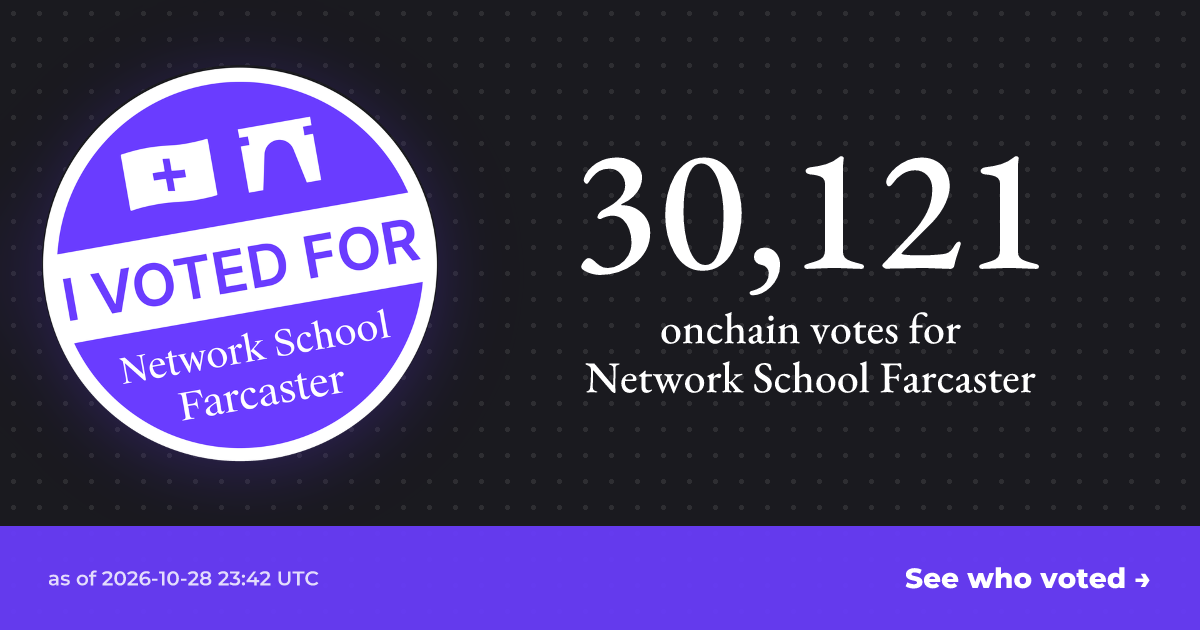
THE FARCASTER PRIZE With 10,000+ votes counted, we're at 94.4% support for the new Network School Farcaster. Dylan put together a great visualization of this first decentralized digital democratic election. In his post below, you can see the provable, onchain, cryptographically verifiable votes streaming in for the new social smart contract. As a thank you, Dylan is the first recipient of a Farcaster Prize for positive-sum behavior on the platform. We've awarded $1024 to dylanb.eth via Base at the public address he listed[1,2]. Importantly, we're going to make systematic use of prizes to fund public digital infrastructure on Farcaster. This will be how we bootstrap a true cryptoeconomy. Because once we can get useful digital work done here for the core platform, we can bring many digital employers to Farcaster. And we have plenty of capital allocated for the bootstrapping phase. So: go read the developer docs (docs.farcaster.xyz/developers), and you can be the next Dylan. More to follow soon, and congratulations to dylanb.eth! [1,2]: See reply for proof-of-payment to dylanb.eth's public Base address.
Hello everyone! Network School is acquiring Farcaster. Our goal is to turn this client into a family-friendly place where you can learn technology, earn cryptocurrency, have fun with the community, achieve your milestones in life, and gradually build a high-trust offline society. Anyone of any race, religion, class, or nationality is welcome so long as they cooperate with other members and share broadly techno-optimist values (a16z.com/the-techno-optimist-manifesto/). To get there, we’ll need a new moderation policy. Rather than the Soviet Union of digital tyranny which typified the 2010s, or the Somalia of lawless digital anarchy that characterizes today’s online environment, we seek to intentionally build the first Singapore of social media. We get there in four steps: institute law-and-order, create a decentralized democracy, publish a written social smart contract, and then hold an ongoing series of meetups with our newly invigorated community. (1) Step one is law and order. In the pre-Internet world, it was simply unheard of to run up to a stranger and start cursing at them. We’re restoring that offline norm online. Much like how President Bukele jailed a small fraction of repeat offenders to essentially eliminate crime (https://tinyurl.com/39hwed77) in El Salvador, we’ve moderated out the small fraction of repeat offenders that have been muted or blocked by many accounts to stop random attacks within this Farcaster reference client. We’ve done this by using both humans and AI to crunch millions of posts. Of course, there will always be some false positives, and we do have an appeals process in the event you either (a) believe your account was unfairly moderated or (b) believe you were fairly moderated, but want to commit to changing your behavior in the future. From one vantage point, other social media platforms have had a moderation-and-appeal process for a long time, so in one sense we’re really just catching up on technical debt and getting to industry standard. However, in another sense, unlike pre-existing tech platforms, we’re actually being very concrete about the techno-optimist values we stand for — and giving you a concrete democratic choice over your digital governance, which leads us to step two. (2) Step two is decentralized digital democracy. As described at farcaster.xyz/~/vote, you can vote with your crypto wallet, your onchain ballot, and eventually your feet (via a Farcon/NS meetup) for our social Singapore. Many of you have already done so, like @linda, @mazmhussain, and @phil. In fact, as of the time of this writing, we’re at 92.9% support for Network School Farcaster, and you can see the onchain votes provably streaming in here: basescan.org/token/0x4ecfed276c566aeb49da1f3a888e8dbb7263028d Of course, you can also vote for another client, or build your own. After all, the Farcaster client has been open sourced (github.com/farcasterxyz/client), and the Farcaster protocol is already open. So with today’s AI tooling you can rapidly boot up whatever client you want. The only limitation is the same one the Ethereum Foundation implements: you can’t use Farcaster, Warpcast, Neynar, Network State, or Network School-related names to launch any coin, token, or commercial project. You can use the Farcaster protocol under the hood, just like Google uses Linux under the hood, but you can’t call your app or digital asset Farcaster itself. The goal is to prevent user confusion and crypto scams. (3) Step three towards building the first Singapore of social media is to publish examples of good and bad behavior, what an earlier generation might call “Goofus and Gallant.” We have a v1 of the social smart contract and the corresponding "Network Code" up at farcaster.xyz/~/contract. We’ll update it over time with specific AI prompts, concrete examples of pro-social behavior that we want in the app (like posting technical tutorials, hosting offline events, and the like) and also examples of anti-social behavior that we don’t want. (4) Finally, step four is to begin hosting online and offline meetups with the community of members that have opted into the new vision. We may do a meetup like Farcon (https://farcon.xyz), an in-person event at Network School in Astana, or an online event like our previous 1729 VR meetups (https://x.com/mckaywrigley/status/1466287496589840392), or all of the above. In each case, admission will be at least partially token-gated to those who voted for the new social smart contract. This way we start from a baseline of common values, techno-optimist goals, and provable democratic legitimacy. From that solid foundation, we can build a true digital community. And together we can cooperate at a scale no social network has ever seen before. So, that's the idea. We’re looking forward to building the first Singapore of social media with you. If you want to join us, please make your choice at farcaster.xyz/~/vote.
Farcaster is still the best protocol of its kind. Much potential remains.
Dan, Varun, and the team built something amazing and useful. Farcaster is by far the best open social protocol around. I want to see the Farcaster protocol grow in @rish and Neynar’s hands. Sometimes protocols take a little while to incubate. The silver lining to this transition could be that the Farcaster protocol will become even more decentralized. I will talk to Neynar and figure out how best to continue supporting Farcaster builders. There is still amazing potential in this mature and functional protocol. Especially with the rise of Claude Code, I feel people could build 10 demos a day to show what’s possible, and one of them could take off.
All Farcaster network staters that are in town for Token2049 or Solana APEX should come. https://farcaster.xyz/balajis.eth/0x68872c39
Of the top ten assets: - six digital companies - one digital currency - three physical commodities So, the 20th century American economy is nowhere to be seen. It’s been deprecated in favor of the virtual 21st century and the physical 19th. The future and the past, together against the present.
I agree with this. As crypto is a community. That grows by millions every year. So what we build for the base today… …is used by normies tomorrow. Thus we can be all-in on crypto. In a user-friendly way, of course. In a high-trust way, too! But also in a straightforward way. Because the world is going onchain.
Ten thoughts on AI. https://balajis.com/p/ai-is-polytheistic-not-monotheistic
Come to Singapore on October 3. ns.com/conference2025
The best thing about Farcaster is that it’s an open backend that can be used to create many different kinds of frontends. The initial Twitter clone flagship app shows how to use accounts, posts, likes, a feed, and other tools. And it also packages a wallet, embedded apps, and soon DMs. But it’s only partially an app. It’s really a dev kit. Showing the sophistication of what can be built.
A map of the cloud predicted the pope.
🙂 All right. Let’s go a few rounds. Our mutual friend @mazmhussain can adjudicate. (1) First: startup societies are based on 100% consent. No one is there who hasn’t chosen to be there. No one is in a hierarchy if they haven’t opted into that hierarchy. Signing the social contract to join a community is much like signing a contract to join a company: you view the docs, make an informed decision, and opt out if it doesn’t work. That right to exit is the fundamental right. (2) Second: not all existing laws are good laws, like the PATRIOT Act. Sunsetting *some* laws doesn’t mean you don’t believe in laws in the abstract. (3) Third: you likely have views on what your ideal community would be. Maybe it’s a vegan village. Maybe it’s modern Amish, where tech is paused at the level of flip phones and people enjoy each other’s company. If you ever decided to build such a peaceful, opt-in community, then we would support you. And that’s what startup societies are about.
I am hiring Farcaster devs. As context, I’m the former CTO of Coinbase. While there I drove our transformation from a four asset company (BTC, ETH, BCH, LTC) to the infinite asset backend Coinbase has now. I also championed and led the USDC launch at Coinbase, taking it from $0 to $1. And worked closely with @dwr.eth, who has been a friend for 10+ years. So, if you want to build real crypto products — not gambling, not vaporware — come work with us. I think Farcaster is exceptionally underrated as a protocol and want to use it as the backbone for a new kind of crypto-first school. To motivate: imagine if every problem you solved in college doubled as a portfolio piece — as a *proof-of-learning* NFT added to your public ENS. That would build a new kind of AI-proof verifiable resume. And that is what we want to build on Farcaster. So, come work with us! https://jobs.ns.com/33467
My strong impression is that Farcaster’s feed is much more positive than the feed of other sites. Who wants to prove that with a sentiment analysis?
Dan is correct. Products will be built on Farcaster. I want to use it as the social login for crypto. For both online *and* offline worlds. Which is different from all pre-existing use cases of other networks. Twitter login is closest, but it's nowhere near as open.
Many problems can be solved by simply typing faster. Writing code? Type faster. Making slides? Type faster. Creating content? Type faster. Deals don’t work like this, negotiations don’t work like this. Those involve other people. But for a large class of problems, the only blockers are your fingers. Type faster.
What is the emergent culture of Farcaster?
From fully automated luxury communism to fully automated laissez-faire journalism. Here’s what we want next. First, make it look exactly like NYT. They publish your info without consent, so parodic turnabout is fair play. Second, allow anyone to paste in casts to generate an article. You are the reporter now.
I have ideas on next steps after the Network State conference. But I’m interested in yours. What’s next?
No politician, regulator, or policeman found the fraud. The blockchain did. Up to the end, SBF said “assets are fine”. But millions could independently fact check him by testing their ability to withdraw. SBF fooled the State, but met his match in the Network. https://balajis.com/p/crypto-twitter-found-sbfs-fraud
Here’s the full program and all details for the Network State conference! Doors open in less than 32 hours. https://x.com/balajis/status/1718399824456736799?s=46